Manufacturing
Continuous measurement on the streams that matter.
AquaMesh reads process water in place rather than on a sampling schedule, and connects what it sees to what the line was doing at the time.
- Reads
- UV/Vis spectra, solids, turbidity, organic load, conductivity context
- Connects to
- SCADA, PLC, historian, LIMS, production records
- To start
- Existing data only — no new hardware
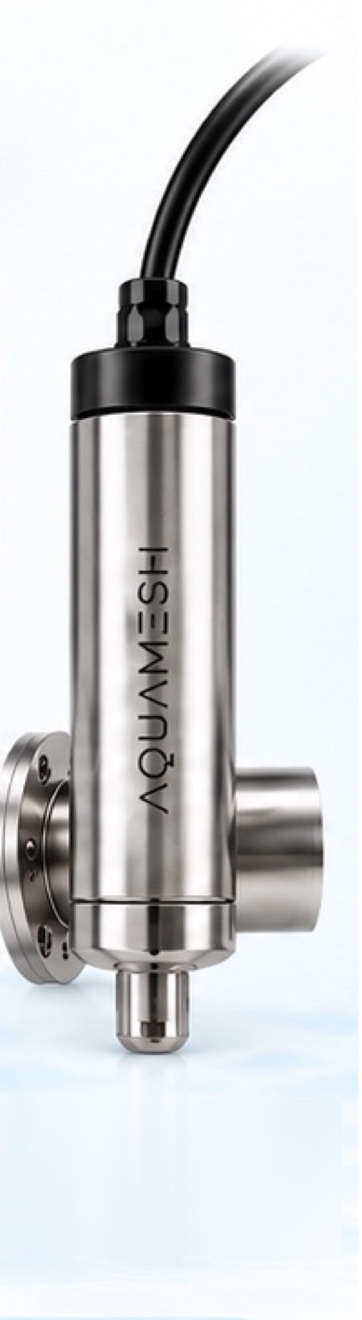
AquaSpectra™ smart probe
What conductivity cannot tell you.
Conductivity says there are ions in the water. It cannot say whether they are harmless salts or the product you just carried out of a rinse tank. The spectrum separates the two.
- Organic carryover, separated from salts The spectral response distinguishes organic load from dissolved solids, which a single conductivity reading cannot do.
- Early indication on hydrocarbons Aromatic and hydrocarbon content give a distinct optical response — useful as an early warning ahead of a discharge sample.
- Continuous through dirty water Built to keep reading in fouling-prone streams rather than needing a clean, conditioned sample.
- Reagent-free and in place No sample line to maintain and nothing to refill, so it can sit on a stream nobody wants to service weekly.
- Reads for
- Spectral change correlated to carryover, solids and organics — alongside the conductivity you already have
- Typically sits on
- Rinse and wash tanks, cooling circuits, process water make-up, discharge to sewer
What we find
What usually turns up on the water side.
These four turn up in most plants we look at. The examples beneath each are the shapes they take in manufacturing — your own data decides which are real at your site.
-
Product and utilities leaving in the water
Water is usually the last stream anyone watches, which is why recoverable value tends to leave through it.
- Product or additive carried into a rinse or wash stream
- Reusable water going to drain because nothing measures its quality
-
Parallel equipment drifting apart
Two circuits on the same duty should look the same. Divergence is usually the first sign of a problem.
- Parallel cooling circuits behaving differently under the same load
- Two lines producing different effluent from the same recipe
-
Settings that cover a worst case every day
Where the risk is invisible, the safe setting is chosen — and then paid for continuously.
- Blowdown and chemical dosing set to cover the worst case
- Chiller or compressor setpoints inherited from the last engineer
-
Instruments that stopped telling the truth
Between scheduled samples, an instrument nobody checks is an assumption.
- A conductivity probe reading flat for months
- Duplicate meters that no longer agree with each other
What you actually get
A ranked list of things to do, each with a number on it.
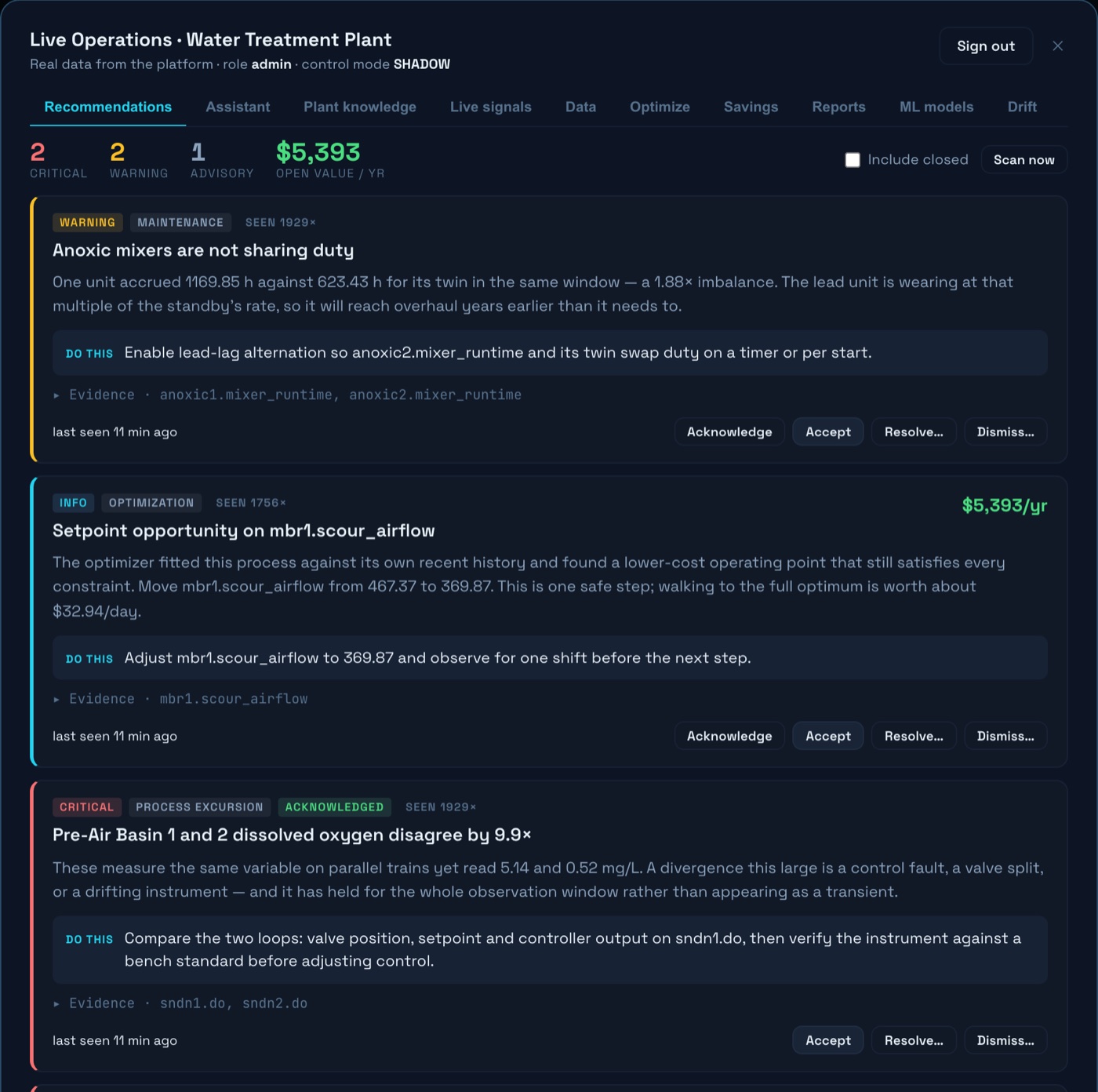
Not a dashboard to interpret. Findings arrive with the action, the tags that are the evidence, and what the change is worth a year — to accept, resolve or dismiss.
Working together
Built for your plant, not from a preset.
- 1
Free audit
On the data you already keep. Start with the stream you have wondered about.
- 2
Your process, modelled
Modelled against your specification limits, not a textbook range.
- 3
Sensing where it pays
Usually one or two points. The audit says where existing instruments already answer the question.
- 4
You stay in control
Advisory by default, clamped to limits your engineers set, every approval logged.
Which stream would you start with?
Tell us the one that has caused trouble before, and we will look at what your data already shows.
AquaMesh is advisory by default: it recommends, your operators decide, and nothing writes to your control system unless you turn it on.