Industrial Water
Everything your plant already recorded.
AquaMesh reads the history your historian already holds, models how each signal and each pair of parallel units normally behaves, and prices what it finds.
- Reads
- Historian tags — flow, pressure, airflow, runtime, DO, turbidity, MLSS
- Connects to
- SCADA, PLC, historian, CMMS, LIMS
- To start
- A data export. No site visit required
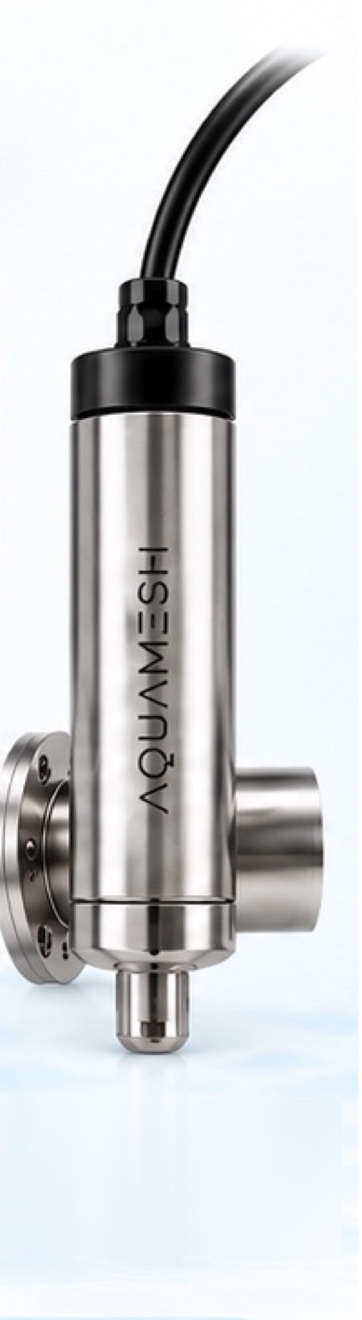
AquaSpectra™ smart probe
Continuous numbers between the lab’s samples.
Your lab stays the reference. AquaSpectra fills the hours in between by watching the whole spectrum for change and tying it to what your plant is doing.
- BOD calibrated to your own samples The one parameter we calibrate, built against your lab results so the method of record does not change.
- Change analysis across the whole spectrum Rather than reporting a fixed parameter list, the platform watches the fingerprint move and correlates it with the things that matter at your plant.
- Load arriving, before the basin feels it A shift in the spectrum shows load on its way in, which gives aeration and dosing a chance to respond rather than react.
- Reagent-free and in place No sample conditioning, no consumables — it keeps reading in water that would foul a conventional analyser.
- Reads for
- Spectral change across the full fingerprint, correlated to load, solids and process state — with BOD calibrated to your samples
- Typically sits on
- Influent, aeration basins, membrane permeate, final effluent and reuse lines
What we find
What a treatment plant’s history usually gives up.
These four turn up in most plants we look at. The examples beneath each are the shapes they take in water and wastewater — your own data decides which are real at your site.
-
Energy going where it is not needed
Air and pumping are the two biggest bills in a treatment plant, and both are easy to over-supply without anyone noticing.
- Air pushed into a basin already sitting at its posted range
- Recovered water sent to disposal rather than to a reuse demand
-
Parallel equipment drifting apart
Twin basins, twin pumps and twin trains should agree. When they stop, it is usually a valve or a setting.
- One of two duty pumps carrying twice the run hours of its twin
- Twin basins on shared airflow reading very differently
-
Setpoints inherited rather than chosen
Commissioning settings are rarely revisited, and each one was defensible on the day it was made.
- Scour or aeration setpoints unchanged since the plant was handed over
- Pumping duty landing inside peak tariff hours
-
Instruments that stopped telling the truth
A signal that stops moving raises nothing. It has to be looked for.
- Zone totalisers that quietly stopped recording
- A quality tag reporting at the wrong scale for months
What you actually get
A ranked list of things to do, each with a number on it.
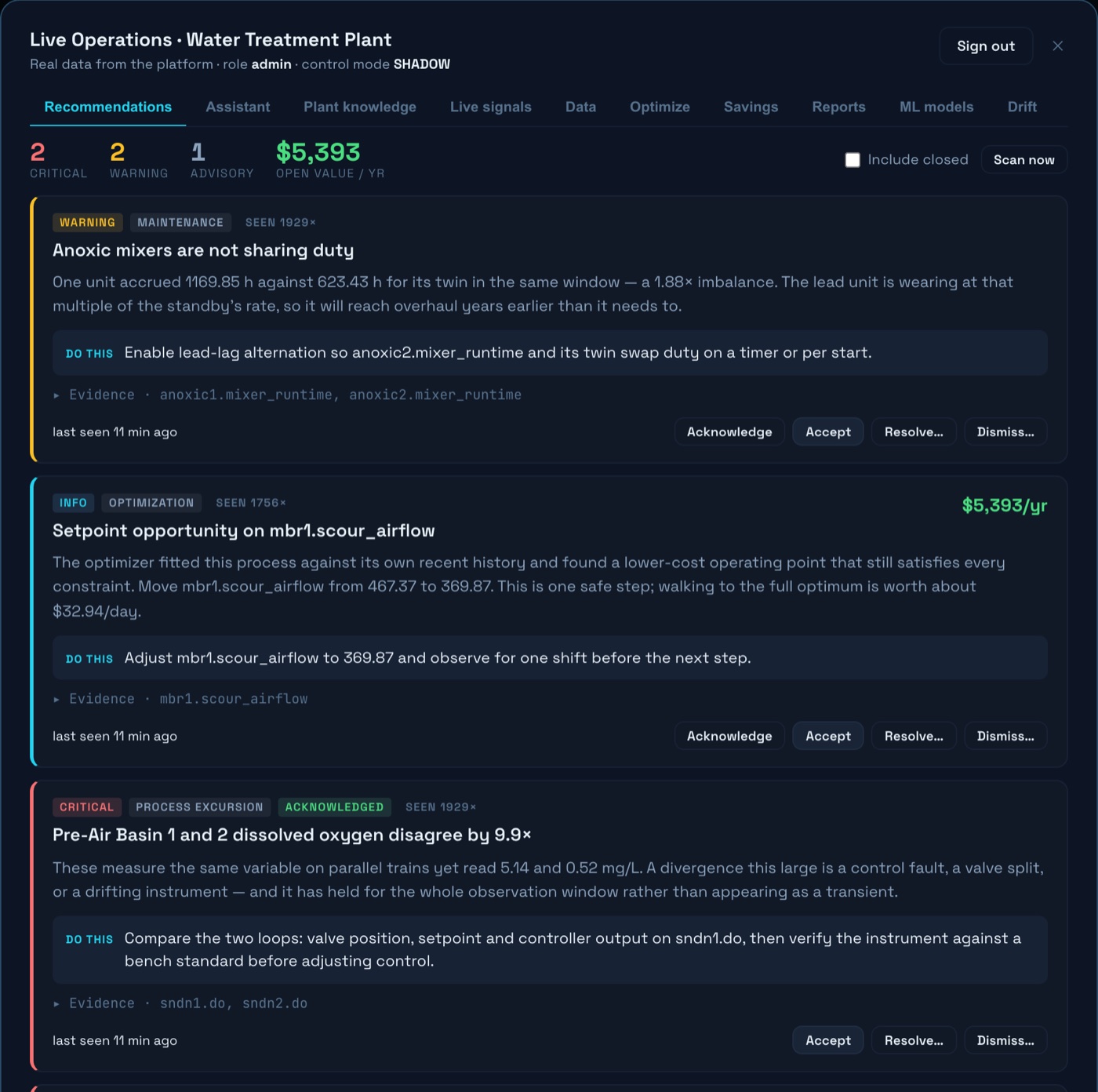
Not a dashboard to interpret. Findings arrive with the action, the tags that are the evidence, and what the change is worth a year — to accept, resolve or dismiss.
Working together
Built for your plant, not from a preset.
- 1
Free audit
On 25 days of your historian. No site visit needed.
- 2
Your process, modelled
Checked against the ranges your own sampling schedule publishes, not a textbook value.
- 3
Sensing where it pays
The instrumentation phase is quoted separately, so capital stands on its own.
- 4
You stay in control
Advisory by default, clamped to limits your engineers set, every approval logged.
Send an export. See what is in it.
If your plant keeps a historian, AquaMesh has something to read.
Capabilities described here are general. Figures quoted in the diagram are from one anonymized AquaMesh audit and are specific to that plant.